Showing posts with label Hyundai. Show all posts

Thursday, January 2, 2014

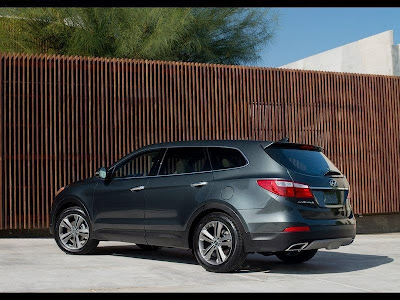
Hyundai Santa Fe model year 2013

0 comments

Hyundai ,Santa, Fe ,model ,2013 ,From ,the, inside
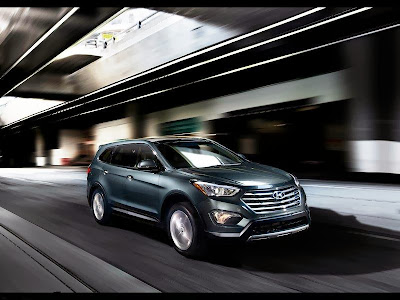
The production version of the new three row six seven passenger Hyundai Santa Fe made its world debut at the 2012 Los Angeles Auto Show, joining the two row five passenger Santa Fe Sport which has been on sale since August 2012 The all new Santa Fe delivers Hyundai's recipe of bold design, high output powertrains with Gasoline Direct Injection  GDI and a host of features to please drivers and passengers with high expectations for functionality versatility and comfort Pricing will be announced closer to the on-sale date in early 2013

NO LINES STANDING STILL

Hyundai designers crafted Santa Fe Sport and three-row Santa Fe together with the signature differentiating element being the side view daylight opening  side window shape  the larger Hyundai Santa Fe features a shape that highlights the increased passenger and cargo room behind the third-row seat. Hyundai Santa Fe also has its own bodyside character lines from the B-pillar back, grille design, 18-inch Euroflange alloy wheels chrome tipped dual exhaust and a flush mounted tow hitch design

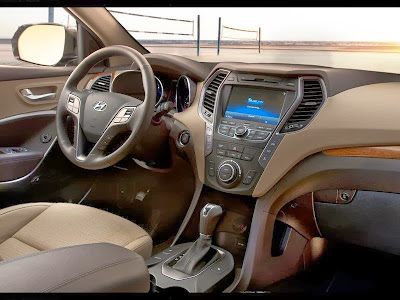
Both Santa Fe trims feature the same flowing interior look, designed for passenger functionality and comfort. From the available heated rear seats and eight-way power driver seat with four-way lumbar support, to a standard 40:20:40 folding rear seat back, both models boast flexibility and a pleasant cabin for all. Also new for 2013 - and standard on all Hyundai Santa Fe equipped with cloth seats - is a 'YES Essentials' seat fabric treatment that provides soil-resistant, anti-odor and anti-static properties for added longevity and livability. Special care and attention went into other interior details, such as an optional panoramic sunroof, which allows more natural light into the cabin and rear side window sunshades. Available on Santa Fe models, is a push-button starter with proximity key, Electroluminescent Gauge Cluster with color LCD trip computer and a heated steering wheel.

The three-row Hyundai Santa Fe increases second-row legroom by 1.9 inches and cargo capacity 5.5 cubic feet and features standard rear-passenger HVAC controls and vents to increase family comfort, while also offering a standard 50:50 split folding third-row bench seat with 31.5 inches of legroom. Second row captain's chairs are also available on the three-row Santa Fe.

HIGHLY ACCLAIMED LAMBDA 3.3-LITER GDI V6 ENGINE

The Hyundai Santa Fe is powered by the highly acclaimed 3.3-liter V6 engine, which is also found in the Hyundai Azera. This V6 engine will suit a shopper's needs in terms of towing, drivability and fuel economy. The Santa Fe's Lambda II 3.3-liter GDI also has a high-pressure direct injection system  over 2,200 psi which dramatically increases power and torque, while reducing fuel consumption and emissions. This system eliminates the need for a large displacement V6 engine and increases the compression ratio for greater thermal efficiency and output. Santa Fe's V6 tow rating of up to 5,000 pounds is perfect for towing small boats or weekend toys. The three-row Hyundai Santa Fe's powertrain was tuned in Ann Arbor, Michigan to satisfy American driving expectations.

SIX-SPEED AUTOMATIC TRANSMISSION

The Lambda V6 engine is mated to Hyundai's six-speed automatic transmission with SHIFTRONIC® manual control. This transmission offers smooth shifts and a wide ratio spread that suits the engine's characteristics. An automatic transmission warmer is included to keep the transmission oil at its optimal temperature, which improves real world fuel economy.

Additionally all models have an Active ECO System that modifies engine and transmission control to smooth out throttle response to help increase real-world fuel economy by 5-7 percent

 DO ANYTHING CAPABILITY" WITH TORQUE VECTORING CORNERING CONTROL

Santa Fe customers will feel the benefits of the optional Active Cornering Control All-Wheel-Drive  AWD system which cooperatively controls torque and braking in conjunction with the Vehicle Stability Management System. This system can anticipate traction requirements and deliver additional stability through braking via continuous monitoring of driving conditions compared with other AWD systems, which can only react to conditions after they occur The Dynamax AWD system supplied by Magna Powertrain access an intelligent control unit that continuously analyzes data from the vehicle controller and distributes torque to any single wheel at a time through a multi-clutch plate The coupling system is fully controllable via an electro hydraulic actuation system Braking force can also be sent to any single wheel at a time via the software These processes are known as torque vectoring and torque braking All this analysis is completely transparent to the driver

Drivers of the Hyundai Santa Fe equipped with Active Cornering Control AWD will realize the following advantages

    Improved lateral stability while cornering
    Removal of unintended over and under steer by reducing unwanted traction to the front and rear axle
    High thermal capacity which helps prevent overheating during hill climbs and trailer towing

In addition, greater efficiency is achieved through the intelligent control electronics that provide the torque needed for enhanced traction in a variety of driving situations  As a result lower fuel consumption and reduced emissions are achieved. The electronic components are also optimally sized for minimal energy usage This intelligent system allows for even more driver control

All 2013 Santa Fe trims feature Hyundai's Hillstart Assist Control  HAC and Downhill Brake Control  DBC to maximize control on steep hills HAC minimizes rolling backwards on steep ascents, while DBC helps the driver maintain vehicle control and speed on steep downhill descents. By selecting the DBC switch, the Hydro Electronic Control unit manages the wheel speed sensors steering angle sensor and acceleration sensor to maintain control and speed on steep declines without having to use the brake

FUN-TO-DRIVE CUV DRIVING DYNAMICS

For enhanced ride performance Hyundai Santa Fe Sport Santa Fe Sport 2.0T and the three-row Santa Fe employ a compact and light MacPherson strut front suspension and a fully independent multi-link rear suspension The front suspension has a 26 mm hollow stabilizer bar to save weight. The rear suspension uses a 21 mm solid stabilizer bar in the front wheel drive and 19 mm solid stabilizer bar in the all-wheel drive Hyundai Santa Fe The larger Santa Fe sits on 18- or 19-inch wheels

Behind the wheel, drivers benefit from Hyundai's all-new Driver Selectable Steering Mode, with three operating modes  Comfort, Normal and Sport This innovative system allows drivers to adapt the Santa Fe's steering characteristics to varying driving preferences and road conditions Comfort mode is ideal for city and parking environments, offering the greatest ease of steering with a 10 percent decrease in steering effort from Normal mode Normal mode is ideal for a mix of driving conditions  Meanwhile Sport Mode is optimized for higher-speed freeways or winding roads and decreases power steering assist by 10 percent from Normal mode. The Driver Selectable Steering Mode not only adjusts power assistance levels in each mode but also adjusts on center build-up feel and steering build-up curves throughout the steering range for a very natural and progressive feel Steering dampening characteristics active return and friction levels have also been optimized in Hyundai Santa Fe

SANTA FE CABIN SPACE ADVANTAGE

The sleek design of the Santa Fe combined with Hyundai's expertise in interior engineering delivers a great presence on the road, while improving functionality and convenience. The spacious cabin has more passenger and cargo volume along with second and third row leg room than Toyota Highlander. Seating utility is also improved, due to a standard 40:20:40 folding rear seat back. This seat back is perfect for seating five passengers comfortably or accommodating four passengers, plus long items like skis, golf clubs, snowboards or surfboards. Fold down two seats to seat three people and hold larger packages or fold all rear seats to maximize cargo space The three-row Hyundai Santa Fe also features a power liftgate for added convenience

Santa Fe include a number of convenient standard stowage and storage features  including an overhead console sunglass holder, two front and two rear seat cupholders door bottle holders enlarged central storage console front storage bin, front seat back pockets and generous under-floor cargo storage

Dual-zone climate controls ensure a comfortable environment for all occupants during long journeys The dual-zone climate controls also incorporate an automatic defogging system, which detects humidity levels using a sensor and removes it from the windshield Another premium feature is a CleanAir Ionizer that produces negatively charged ions to purify the air when the heater or air conditioner is running

OVERALL DIMENSIONS

The larger Hyundai Santa Fe rides on a 110.2-inch wheelbase, which is 3.9 inches longer than the Santa Fe Sport's wheelbase. Its overall length of 193.1 inches is 8.5 inches longer compared to Santa Fe Sport. The 74.2-inch width is slightly wider  0.2 inch than Hyundai Santa Fe Sport. The LWB Santa Fe's overall height is 66.5 inches  which is 0.4 inches higher than Santa Fe Sport

Ultimately the long wheelbase for both models allows for maximum comfort An example of this is found in the second row seat track delivering more second-row legroom The three-row Hyundai Santa Fe's cargo volume is 40.9 cubic feet behind the second row seats and 13.5 cubic feet behind the third row seats

IMPROVED RIGIDITY AND ULTRA-HIGH STRENGTH TENSILE STEEL

The all-new architecture incorporates a new design that not only improves torsional rigidity by 16 percent, it also incorporates a 30-percent increase in the use of ultra high strength tensile steel to improve collision energy management High-strength steel reduces weight and also allows the suspension to work optimally Ultra-high strength tensile sheet metal has also been applied to the outer door panels for the first time in the company's history In addition, anti-corrosion steel was applied to 70 percent of outer frame and floor structure

New hot stamping and roll-forming methods have also been applied to impact members which provide added strength reduces the number of body parts and makes the architecture lighter. The amount of structural adhesives has also been increased significantly for improved body rigidity, crashworthiness and durability

WORLD-CLASS WEIGHT EFFICIENCY

World-class weight efficiency is an essential part of all Hyundai models and the new Santa Fe hits its target. The curb weight for a FWD three-row Santa Fe is 3,946 pounds with AWD models weighing 4,098 pounds Hyundai Santa Fe provides outstanding fuel economy and is 99 pounds lighter than Highlander and 239 pounds lighter than the all new Pathfinder. It is also 320 pounds lighter than the outgoing Veracruz. This priority on weight efficiency allows the three row Santa Fe to deliver carlike handling outstanding acceleration and fuel efficiency

NEW ADVANCED STANDARD SAFETY TECHNOLOGIES: PART OF HYUNDAI'S ASSURANCE COMMITMENT

All models have a standard Vehicle Stability Management  VSM system which optimally manages Electronic Stability Control  ESC and the Motor Driven electric Power Steering  MDPS VSM works to control two effects. The first is when a driver accelerates or brakes on a split-mu surface (slippery on one side dry pavement on the other and the vehicle wants to pull in one direction. VSM detects this condition and sends a signal to the MDPS to apply steering assist. VSM counters the pull and automatically provides eight Newton meters of counter-steering. VSM reacts the same way during sudden lane changes or fast cornering Active Cornering AWD drive models integrate torque and brake vectoring

All Santa Fe models feature seven airbags, including side curtain airbags and a driver's knee airbag along with rollover sensors for the side curtain airbags When the sensors detect a potential rollover the control module triggers the head-curtain side airbags and safety belt pre tensioners to help protect passengers against serious injury

Hyundai Santa Fe also features a state-of-the-art braking package The package includes four wheel disc brakes (12.6 inch front and 11.9 inch rear an Anti-Lock Braking System  ABS including Brake Assist providing maximum braking force when a panic stop is detected, and Electronic Brake-force Distribution  EBD to automatically adjust the braking force to front and rear axles, based on vehicle loading conditions Additionally, Santa Fe offers family-friendly passive safety features, including a Lower Anchors and Tethers for Children  LATCH system for children's seats on the second row and three-point seatbelts for all seating positions

THIRD-GENERATION NAVIGATION AND AUDIO TECHNOLOGY

All Hyundai Santa Fe models offer an optional multifunction eight-inch touch-screen display with navigation. This third generation display features a simpler user interface  enhanced voice recognition commands and improved navigation screens The system is more intuitive to use for commonly used tasks. Simple pop-up messages now appear to help pair a phone. The voice recognition software understands street addresses and cities all in one sentence The route screens display speed limits and details the next three maneuvers One or two button pushes now complete most functions

HD Radio technology is also integrated into all Santa Fe displays An HD Radio icon on the display appears next to the channel frequency to notify the user this station is broadcasting in HD

All models are available with four audio systems. Standard is an AM/FM/Satellite Radio/CD/MP3 audio system with six-speakers and iPod®/USB/auxiliary input jacks. The upgrade audio system boasts a 4.3-inch full color LCD screen with HD Radio and rear view camera. The third system consists of the Gen 3.0 Navigation unit with Dimension audio with 10 speakers. Finally, the premium navigation system includes an Infinity® 550-watt, Logic 7® surround sound audio system with 12 speakers, including an eight-inch subwoofer and external amplifier is available. A SiriusXM Satellite Radio interface is integrated into each head unit and features channel logos and Data services, such as NavWeather Stock Ticker and Sports Ticker A Bluetooth hands-free phone system with voice recognition address book download and audio streaming is also standard. Both navigation systems integrate rear view camera output. Blue Link™ turn by turn navigation is standard on all Santa Fe models complimentary trial period

HYUNDAI BLUE LINK

Blue Link combines safety service and infotainment features to simplify owners lives and reduce distracted driving. Blue Link brings seamless connectivity directly into the car with technology like voice text messaging, POI web search download turn by turn navigation and monthly vehicle reporting Hyundai Blue Link telematics is standard on all Hyundai Santa Fe models with up to a one year complimentary trial period Blue Link can be easily accessed from the buttons on the rearview mirror the web and via a smart phone Blue Link is offered in three packages Assurance  Essentials and Guidance
Hyundai, Santa Fe ,model ,year, 2013, From the inside
Hyundai Santa Fe model year 2013
Hyundai Santa Fe ,model year 2013 From, the ,inside
Hyundai Santa Fe model year 2013
Hyundai Santa Fe ,model year 2013, From the inside
Hyundai Santa Fe model year 2013 From the inside When you sit down
Hyundai Santa Fe model year 2013 From the inside
Hyundai Santa Fe,model year 2013, From the inside

Saturday, December 14, 2013

Hyundai HB20X model year 2013

0 comments
Hyundai HB20X model year 2013 From the inside
Hyundai Motor Brasil  HMB a wholly-owned subsidiary of Hyundai Motor Company, unveiled its latest Brazil-exclusive model Hyundai HB20X at the 2012 Sao Paulo International Motor Show, accelerating the company's commitment in one of the world's fastest-growing auto markets

The crossover version, which is based on the HB20 hatchback features unique details in its design and performance that meet the demands of customers that have a more active lifestyle outdoors

The front has a totally redesigned bumper with a hexagonal grille that reflects Hyundai's new family look for SUVs and latest design philosophy Fluidic Sculpture.

The headlights have an eye catching finish with black bezel and chrome details, giving off a sporty and sophisticated image, while the fog lamps were redesigned to give a stronger impression The side of the Hyundai HB20X keeps the original waistline from HB20, which encompassed a robust and fluidic design

The novelties are the side black molding that wraps the whole body and its ground clearance   valuable features for more visibility and control on bad road conditions. The roof bars offer more flexibility for carrying extra weekend luggage while the 15 inch dark gray alloy wheels complete the sporty image of this vehicle

The rear of the Hyundai HB20X also has a redesigned bumper with black moldings The stylish rear lamps already seen on the HB20, immediately capture one's attention.

Inside, the Hyundai HB20X features the same high quality interior of the HB20 adding exclusive items such as sports pedals, chrome finishing for door handles and air conditioning controls as well as blue double stitches for the steering wheel and seats

HB20X will offer Hyundai's GAMMA 1.6 16V FLEX with 128hp engine featuring a Continuous Variable Vavle Timing and aluminum block, the most powerful in the category Customers can choose between manual or automatic transmissions
Hyundai HB20X model year 2013 From the inside
Hyundai HB20X model year 2013
Hyundai HB20X model year 2013 From the inside
From the inside Hyundai HB20X model year 2013  
Hyundai HB20X model year 2013 From the inside

Thursday, December 5, 2013

Hyundai I30 3-door model year 2013

0 comments
Hyundai I30 3-door model year 2013 From the inside
Hyundai I30 3-door model year 2013 The New Generation i30 provides the best evidence yet of Hyundai's commitment to producing cars in Europe for Europe  combining the design and engineering expertise of the team at the European R&D centre with the proven manufacturing excellence of the company's Czech factory.

The arrival of the company's first ever 'made for Europe 3 door in the segment will further extend the appeal of the i30 range joining the five-door and wagon versions

Conceived solely for Europe the New Generation Hyundai i30 3-door strengthens Hyundai's presence in one of Europe's most competitive vehicle segments  the segment in which the brand has seen its greatest success since 2007 The new bodystyle will contribute to increased sales and just as important, greater brand awareness and enhanced consumer perceptions of Hyundai in Europe

Visually the styling differences between the five-door model and the new 3-door are immediately apparent While both cars bear the influence of the  fluidic sculpture form language that has been inspiring the design of all new Hyundai production vehicles since the ix35 was introduced in 2009 clear contrasts in the front side and rear aspects mark out the 3-door from its better known sibling

New grille fog lamps and lower bumper at the front are echoed at the rear while the profile is noticeably more sporty thanks to a sharply raked beltline more angular glasshouse silhouette and longer front doors. In addition to the existing 17-inch alloy wheels, the New Generation Hyundai i30 3-door also offers exclusive 16-inch alloy wheels and a new orange colourway for the interior trim  including contrasting orange stitching on the steering wheel gear shift knob, upper dashboard and door armrest   complete the visual transformation for the 3-door model

The longer front doors  170 mm longer than the five-door's  not only generate an impression of sportiness but also provide a wider aperture ahead of the B-pillar  making access to the front seats even easier. Rear seat passengers in the New Generation i30 3-door enjoy plentiful space with 38 mm more hip room than the five-door and only 21 mm less shoulder room. Other external and internal dimensions are the same as for the five-door model.

Dynamically and in terms of specification powertrain options and efficiency the 3-door retains the positive characteristics of the five-door engaging the driver with Europe tuned ride and handling and providing quality equipment and comfort to make travelling in and owning an i30 a true pleasure

The highlight of the powertrain range remains the U-II 1,6-litre diesel engine  generating 128 ps while emitting only 97 g/km of CO2 with the Blue Drive package. Together these figures make for the best power-to efficiency ratio in the segment.

The in-house developed technologies known from the five-door are also all available  including Hyundai's own six-speed manual and automatic transmissions and its FLEX STEER system with three settings for variable steering assistance depending on driver preference and prevailing conditions

Allan Rushforth Senior Vice President and COO of Hyundai Motor Europe  commented  The 3-door bodystyle is a valuable addition to the New Generation i30 family extending the appeal of this truly European model for its European target audience We expect to attract more consumers from a wider demographic range to Hyundai including younger buyers drawn to the more dynamic styling and the 3 door proposition

Demonstrating its confidence in the durability and quality of its products Hyundai offers customers of all newly launched products in Europe the industry-best, fully transparent Five Year Triple Care This award-winning package provides five years of unlimited-mileage warranty, five years of roadside assistance, and five years of vehicle health checks and is fully transferable between owners

Fluidic sculpture inspires 3 door's more dynamic design

As with its five-door and wagon siblings, the styling of the New Generation Hyundai i30 3 door was inspired by Hyundai's  fluidic sculpture design ethos This philosophy takes its influences from the flowing lines of nature and modern architecture and it drives the Hyundai design team to create impactful sculptural vehicles with a shared visual identity

In the case of the 3 door model Hyundai has introduced an added dimension of dynamism and a greater sportiness to the New Generation i30 with clear visual distinctions between this and the five door version

Thomas Bürkle Chief Designer at Hyundai Motor Europe Technical Centre  commented  We conceived all three bodystyles simultaneously to ensure that, whether viewed individually or as a family these cars have coherent design and share a harmonious character The 3-door model evokes the most emotional response through its more dynamic appearance making it stand out as the sportiest of the trio  It was our aim to create a successful design for the 3-door that - from every angle   displayed clear points of difference between it and the five-door car

At the front the most striking difference is the new treatment applied to the mesh insert surrounding the central bar in the middle of Hyundai's signature hexagonal grille  Both the bar and the mesh are finished in black accentuating the body hexagon shape. A new finish for the lower bumper includes a body-coloured section which meets the newly profiled lower edge of the grille Sited on either side are new-design fog lamps  sportier in concept than the five door's, with round spots connected to LED daytime running light strips encased in an angular housing and backed by the same new mesh as is embedded in the grille

From the side the already athletic profile of the five door is enhanced on the 3 door by a more sharply raked beltline that creates a more distinctive glasshouse silhouette  The line rises gradually from the wing mirror then cuts up noticeably in line with the leading edge of the rear wheel arch With just as angular a treatment for the top edge of the glasshouse, the 3-door presents a sportier look despite retaining the same overall dimensions as the five door

The rear's lower bumper area has been remodeled, and includes a new horizontal  sculpted design of fog lamps contrasting with the upright units of the five-door  Embedded in a more angular-shaped housing, these contribute to the impression of a wider, sportier rear  and this sense is completed by a new black insert at the bottom of the bumper.

With further exclusive styling features buyers will be able to mark out their 3 door cars from its siblings These include specifying a unique new design of 16-inch alloy wheel only available on the 3 door And in the cabin there will be a new orange trim option that fits with the more sporty image of the 3-door, including orange colour stitching on the steering wheel gear shift knob and door armrest.

Driving fleet growth to a 50% share

Since going on sale in 2007 the original i30 has played an important role in expanding Hyundai's sales and reputation in Europe's fleet sector In its first months on sale the New Generation i30 has already proven to be popular with fleet managers and company car drivers, and the introduction of the 3 door model will extend the appeal of the range

From the sales target of 120.000 units per year Hyundai forecasts a 50:50 split between the fleet and private sectors

Hyundai's Five Year Triple Care will continue to be a valuable point of differentiation for New Generation i30 in a highly competitive class The five year warranty has no mileage limit. Roadside assistance is included for five years and vehicle health checks are performed annually providing peace of mind for fleet buyers fleet operators  company car drivers and private motorists

Compared to the original i30 total cost of ownership for the New Generation i30 model is reduced helped by improved fuel efficiency lower CO2emissions and a lower insurance classification, making the i30 family a rational choice for fleets as well as an emotional one

Generous high quality equipment 'from the class above

The quality and generosity of standard specification on the New Generation i30 have been inspired by the high standards established by Hyundai's all-new i40  demonstrating the company's desire to make its technology available to all European motorists One such example is the heated steering wheel, which debuts on the New Generation Hyundai i30 3-door and is being introduced to the rest of the New Generation i30 range The 3-door is available with the same standard and optional equipment as the rest of the i30 range

Features that will appeal to New Generation i30 drivers include 10 way powered driver's seat adjustment heated front seats electric parking brake, a Smart Key with engine start/stop button and cruise control with speed limiter function Enhanced instrumentation with a TFT Supervision Cluster  executed to the same high quality as found on i40 provides a wide range of additional information to the driver in high-resolution clarity

Located atop the centre stack the optional navigation system is displayed via a 7 inch touch-screen The system is a highly sophisticated and convenient GPS tool offering real-time information, multi-media support and speech recognition in 10 European languages

New features that enhance the New Generation i30 experience for passengers include dual-zone climate control with automatic defogging function, twin ventilation and heating ducts for rear seat occupants and a truly panoramic glass sunroof which allows greatly increased natural light to flood the cabin The sunroof has been designed to open fully or tilt open offering flexibility and functionality, together with an adjustable full length shade Heat-reflecting solar glass is an option for the front side and rear windows

New Generation i30's standard equipment also offers buyers LED daytime running lights, front fog lamps, 6 speed manual transmission, 60:40 split folding rear seat  front power windows with driver auto down, four-speaker audio system and a multi-mode trip computer

Please note Some markets may select particular powertrains and levels of equipment to suit the preferences of their local consumers  perhaps offering some  options as standard on New Generation i30 in their country  Please check the final technical specification and model by model equipment details with your national Hyundai PR staff

Choice of six engines to power New Generation i30

Depending on individual market preferences, the New Generation i30 is available with a choice of six engines  three diesel and three gasoline units  with a broader range of power outputs, from 90 to 135 ps.

New more powerful engines top both the diesel and gasoline line ups delivering 128 ps and 135 ps respectively.

The upgraded diesel engine - the highly-efficient 1,6-litre variable geometry turbo  VGT 'U-II' unit - is among the most popular powertrains in the line-up. Generating 110 ps at 4.000 rpm and 260 Nm from 1.900 rpm, the upgraded 1.582 cc engine accelerates the New Generation i30 from standstill to 100 km/h in under 11,5 seconds, and goes on to reach a top speed of 185 km/h- yet consumes just 4,0 l/100 km on the official combined cycle or 3,7 l/100 km in cars fitted with the Blue Drive package.

The gasoline engines also offer an excellent balance between performance and economy. The New Generation 1,6-litre 'Gamma' GDI engine features technically advanced 'gasoline direct injection' to maximize power and torque generation while minimizing fuel consumption and emissions. This 1.591 cc unit produces 135 ps at 6.300 rpm and 164 Nm of torque at 4.850 rpm. With this engine, i30 accelerates to 100 km/h in only 9,9 seconds and records consumption of 5,7 l/100 km (combined cycle) or 5,0 l/100 km on models equipped with the Blue Drive package.

Both diesel and gasoline engine types play a significant role in the European C-segment, with diesel representing 58% and gasoline 39% of total sales. Overall, Hyundai is expecting a 50:50 split between sales of diesel- and gasoline-powered variants of New Generation i30 models.

Low emissions and real-world efficiency

The addition of Hyundai technologies developed under the company's Blue Drive™ sub-brand optimizes efficiency and lowers emissions for the New Generation i30. These technologies, which are available on both diesel and gasoline models with manual transmission, include Integrated Stop & Go (ISG), low-rolling resistance tyres and an alternator management system (AMS). With CO2emissions from just 97 g/km, combined with an engine delivering 128 ps, the new 1,6-litre diesel i30 features a best-in-class power-to-efficiency ratio.

Together with a generous 53-litre fuel tank, drivers of the new model should comfortably achieve a range of 1.400 kilometres between fill-ups. In other words, a New Generation i30 owner could drive from the car's production home in Nošovice, Czech Republic to the Paris Motor Show in France on a single tank of fuel.

Six-speed transmissions for every model

Buyers of New Generation i30 have a choice between manual and automatic six-speed transmissions, depending on model, with both units providing a refined driving experience. The automatic transmission is an option on all 1,6-litre engines, while the 1,4-litre units will be available exclusively with a manual gearbox.

Enhanced handling and variable power steering

As part of its improved dynamics package, New Generation i30 offers C-segment car buyers the new option of Hyundai's innovative FLEX STEER system. This introduces three operating modes - Comfort, Normal and Sport - and allows the driver to vary the level of steering support to best suit the driving conditions.

The Comfort mode gives greater electrical assistance, offering a 'lighter' steering wheel and minimal effort to reach full steering lock. The improved maneuverability makes city driving and pulling in and out of a parking space easier than ever.

Normal mode is intended to be used most frequently. Offering the best experience across all road types, its flexibility offers a relaxed, yet engaging drive.

Finally, Sport mode offers drivers the most engaging drive with reduced electrical assistance. The steering feels more weighted and best suits highway routes.

The steering system employs electric power assistance and requires 2,85 turns lock-to-lock for a 10,6-metre turning circle.

Fully independent all round, New Generation i30's suspension features subframe-mounted MacPherson struts at the front and a multi-link set up at the rear - both with optimized geometry to exploit the wider track of the new model for enhanced handling and improved road holding.

Generous cabin space and minimised interior noise

The 2.650 mm wheelbase is carried over from the original i30 for New Generation i30 in all three bodystyles, but an increase in overall length and width has been exploited to create more cabin space for occupants and more cargo space for luggage.

In the 3-door and five-door, front seats occupants can enjoy 30 mm more headroom, 11 mm more legroom and 14 mm of additional shoulder room than in the original i30. Rear passengers enjoy improved access across the rear seats, thanks to the floor's central tunnel being lowered by 59% (from 133 mm to just 54 mm).

In the hatchback models, trunk capacity is boosted by 11% to 378 litres (up 38 litres) compared to the original i30, the dashboard glove box is enlarged by 47% to 8,5 litres (up from 5,8), bottle storage in the front door trims is doubled in size to 1,5-litres and new 0,75-litre storage pockets are provided in the rear doors.

In terms of cabin refinement and NVH (Noise Vibration Harshness), Hyundai's New Generation i30 engineering team targeted the segment leaders, and was determined to achieve significant improvements over the previous i30 model.

Measures adopted to improve NVH include vibration damping engine mounts, fitting hollow drive shafts, stronger bodyshell joints between the sills and B-pillars, double-layer door seals, increased foam-filling in the A-pillars and re-shaped exterior door handles.

Class-leading safety features

Safety is a top priority for Hyundai and the New Generation i30 features the latest active and passive safety technologies to ensure maximum protection for its occupants and other road users. Active safety features include ESP (Electronic Stability Programme), VSM (Vehicle Stability Management), ABS (Anti-lock Braking System), BAS (emergency Brake Assist System), HAC (Hill Assist Control) to prevent roll-back and ESS (Emergency Stop Signal) which flashes the brake lights when an emergency stop is detected.

Good visibility is a key factor in safe driving and New Generation i30 features LED daytime running lights - fitted as standard in Europe- to ensure it is seen, plus HID (High-Intensity Discharge) headlamps with AFLS (Adaptive Front Light System) to optimize the driver's night vision. To maximize safety when reversing, a wide angle rear view camera is available, mounted in the tailgate badge (3-door and five-door only) and showing a clear view of obstructions behind the car.

Personal security is also enhanced with New Generation i30 by the 'welcome lighting' package which features puddle lamps beneath the door mirrors and illuminated door handles - triggered by the proximity of the Smart key as the owner approaches the parked car.

In terms of passive safety, the New Generation i30's bodyshell structure employs a high percentage of ultra high tensile steel and features three new cross-members which link to the front or rear suspension mounts for maximized rigidity. The front door anti-intrusion beams have been strengthened, the joint between the B-pillar and roof enlarged while the inner- and outer-side sill panels are manufactured in high tensile steel.

Each New Generation i30 is fitted with six airbags as standard - front, front side and full length curtain - while an innovative driver's knee airbag is optional.

The safety features available on the New Generation i30 reinforce Hyundai's excellent record on safety, and in May 2012 the five-door model was awarded the maximum five-star rating in Euro NCAP's impact assessment programme, including a class-leading 90% score in the 'child occupant' category. It was the seventh consecutive Hyundai model to attain the top rating. In September 2012 the New Generation i30 wagon also received a maximum five-star Euro NCAP impact assessment programme rating 
Hyundai I30 3-door model year 2013 From the inside
Hyundai I30 3-door model year 2013
Hyundai I30 3-door model year 2013 From the inside
Hyundai I30 3-door model year 2013
Hyundai I30 3-door model year 2013 From the inside

Sunday, December 1, 2013

Hyundai HB20 model year 2013

0 comments
Hyundai HB20 model year 2013 From the inside
Hyundai HB20 model year 2013 Hyundai Motor Brasil  HMB a wholly owned subsidiary of Hyundai Motor Company launched its long-awaited Brazil-exclusive model officially entering the biggest and most competitive segment in the country's auto market

The Hyundai HB20 compact hatchback will be the first model to be produced at Hyundai's fully-owned new plant in Piracicaba, which will officially hold an opening ceremony later this year Production of the new vehicle will begin on Sept 20 while sales will begin in early October

 For Hyundai the launch of HB20 means a lot more than simply presenting a new model. Unlike our other models currently offered in Brazil, HB20 is the first model strategically developed and produced exclusively for the Brazilian market. This new car is optimized to the taste of Brazilian consumers and the driving conditions in this country with years of dedication from our engineers. I guarantee with pride that HB20 will change the perception of Brazilian customers in the small car segment Chang Kyun Han, President of HMB, said at the launching event, which was held at Hotel Transamerica Ilha de Comandatuba in the eastern Brazilian state of Bahia yesterday

Offering modernity and equipped with the latest technologies to differentiate itself from the competition, all nine versions of the Hyundai HB20 will have a comprehensive package of items offered as standard from entry levels: Hydraulic power steering dual front airbags, air-conditioning, a spoiler with a built-in brake lights a rear windshield wiper and storage compartments for all passengers, to name a few The name  HB stands for Hyundai Brasil, while the number  20 is the company's characterization for vehicles in this segment, a category that includes models assembled on small or compact vehicle platforms

Hyundai dedicated approximately five years to develop the new model which is part of the company's larger regionalization strategy. Dozens of Brazilian and Korean engineers were involved in the project during the conception phase to develop an ideal car that could handle Brazil's typical road conditions as well as satisfy consumers' emotional needs Mainly, Hyundai placed great importance on design, taking into account Brazilian consumers  sensitivity to stylish and fuel-efficient cars  HB20 Hyundai's first flex-fuel car also features advanced anti-theft functions for maximum security

Design

The Hyundai HB20 is a compact and economical model that is poised to become a benchmark in style due to its flowing lines excellent finish and the quality of its assembly

Based on Hyundai's Fluidic Sculpture design philosophy, HB20's external details accentuate the modern and sporting lines of the hatchback. Its high waist-line and rear accentuates its stylishness and exclusivity

The Hyundai HB20's interior also differentiates itself from competitors with its modernity, sophistication, comfort and practicality The impressive details and high quality of its finish are immediately noticeable, while chrome, metallic and leather covered parts are options that enhance the model's stylishness even more. In its search to maximize consumer comfort, the HB20 has achieved some of the lowest noise and vibration levels in its class while the spacious interior will surprise consumers

Powertrain & Transmission

The Hyundai HB20 comes with three powertrains  1.0L and 1.6L with a manual gearbox and 1.6L with automatic transmission

The vehicle's 5-speed manual gearbox has precise and perfect shifting providing comfort and a rapid response The automatic option has four gears with smooth changing

All versions are equipped with a flex-fuel engine. The 1.0L model has three cylinders and gains in power due to reduced friction and better energy efficiency, leading to lower fuel consumption, a reduction in pollutant emissions and lower maintenance costs It is considered to be 6% more powerful than the segment's average The 1.6L version has four cylinders and emits 23% more power than the segment's average

The Hyundai HB20 is equipped with a continuous variable valve timing  CVVT which optimizes the air fuel mixture both at low and high RPM leading to improved performance and fuel consumption

The HB family will also have sedan and crossover versions that will come to market during 2013 The three models will all be produced at Hyundai's first plant in Brazil  The Piracicaba factory covers 1,390,000 square meters of land, of which 69,000 square meters will consist of facilities The plant is Hyundai's seventh overseas manufacturing base outside South Korea after Turkey, India, China, the United States  the Czech Republic and Russia The company invested a total of US$ 600 million in the facilities

HMB has already hired 1,600 employees with plans to increase this figure to 2,000 by 2013 Hyundai's Piracicaba plant together with its suppliers, will create an additional 3,000 jobs It will also indirectly generate 20,000 jobs in the region
Hyundai HB20 model year 2013 From the inside

Saturday, November 23, 2013

Hyundai I20 model year 2013

0 comments
Hyundai I20 model year 2013 from the inside
Hyundai I20 model year 2013 The new Hyundai i20 represents another step in Hyundai's product development and features a number of changes both inside and out along with the option of a new ultra-efficient and clean 1.1-litre diesel engine.

Its exterior design has received a number of contemporary enhancements to bring it visually more in line with the rest of the i-range. Inside, the New i20 majors on quality with improved plastic materials, a revised and classier centre consol along with updated seat trims.

Among the four powertrain options available to buyers of the new Hyundai i20 will be the new 1.1-litre, three-cylinder 'U-II' diesel engine that develops 75ps. When combined with Hyundai's Blue Drive technologies, this derivative emits just 84g/km of CO2, making it the lowest emitting diesel combustion powertrain on sale today. The engine was developed at Hyundai's Diesel Centre of Excellence - part of the European R&D set-up in Rüsselsheim, Germany - and showcases Hyundai expertise in clean diesel technology.

This ground-breaking new engine will be offered alongside another sub-100g/km diesel powerplant in the form of the 90ps four-cylinder 1.4-litre 'U-ll' engine that emits 96g/km with the aid of Hyundai's Blue Drive technologies. Completing the line-up are two petrol engines: an 85ps 1.2-litre and a 100ps 1.4-litre.

The Hyundai i20 is available in three main trim levels beginning with Classic, moving up to Active and followed by Style. Starting with Classic, each model comes with a generous list of standard specification including remote central locking, six air bags, air conditioning, ESP and, for the first time on i20, Vehicle Stability Management.

Hyundai has added in even more value to the i20 package with the Active trim, which adds 15-inch alloy wheels, Bluetooth with voice recognition, electric/heated door mirrors, front fog lights, leather steering wheel and gear knob and electric rear windows (five door bodystyle) when compared with Classic.

The range-topping Style model is equipped with 15-inch alloy wheels, automatic headlights, rain-sensing front wipers, climate control along with an automatic dimming rear view mirror with an integrated reversing camera - the first standard application of this technology in the segment.

These standard features are traditionally only found on bigger and more luxurious cars as optional extras, but with the Hyundai i20 they are all part of the overall package.

Buyers wanting even higher levels of technology and features can order the Convenience Pack, which encompasses keyless entry, engine Start/Stop button, chrome exterior door handles and supervision cluster.

Tony Whitehorn, President and CEO Hyundai Motor UK, says: "The New i20 is yet another model to join Hyundai's new-look model range and will appeal to existing customers but will also prove an attractive choice for young buyers who may not have considered Hyundai in the past. It has been given a thorough revision both inside out. With high levels of specification will appeal to customers who want value for money without compromising on quality.

"In addition, the i20 range will feature the cleanest internal combustion diesel engine emitting just 84g/km. This showcases Hyundai's considerable efforts in optimising existing technologies to reduce fuel consumption and emissions from its range of cars. As with all new Hyundai cars, the i20 is backed by our 5 Year Triple Care warranty for complete peace of mind."

Prices for Hyundai i20 start at £9,995 on-the-road for the three-door 1.2 petrol Classic model, while at the other end of the spectrum the range-topping 90ps 1.4 CRDi Style model costs £14,295.

Evolution into fluidic design

Re-designed at Hyundai's European headquarters in Germany, the New i20 has been styled using Hyundai's signature design language, 'fluidic sculpture'.

The front-end has been updated to feature a design element common to all new Hyundai models - the hexagonal-shaped grille. New headlights have been added to give the Hyundai i20 a contemporary look while the bonnet, front wing, front bumper - which incorporates fog lights - and wheel designs have been updated too, adding to the new car's fresh new look.

At the rear, Hyundai's designers have modernised the car with a makeover that includes an updated bumper design featuring integrating rear parking sensors. The rear lamps have also been restyled to complete the car's flowing and attractive design.

For the UK market, Hyundai i20 will continue to be manufactured at Hyundai's plant near Chennai, India, and made available with a range of 6 exterior colours - two solid and eight metallic or pearl. Customer choices include Coral White, Sleek Silver, Coral White, Electric Red, Black Diamond and Ember Grey.

The redesigned bumpers at the front and rear of Hyundai i20 have added 55mm to the car's overall length (30mm at the front and 25mm at the rear), taking the total measurement to 3,995mm. The overall width, height and wheelbase remain the same as the outgoing model, maintaining its dynamic proportions.

Enhanced materials and generous space

Inside, Hyundai i20 has been updated to provide drivers and passengers with an enhanced level of interior comfort and roominess. The centre fascia has been reworked to incorporate more sophisticated switchgear along with new piano black, high-gloss inserts on the dashboard for a classier appearance.

The Hyundai i20's interior benefits not only from material upgrades, it also provides outstanding levels of roominess front and rear for a B-segment car. Headroom in the front is a generous 1,005mm and 970mm in the rear. There is also 1,350mm of shoulder room in the front and 1,340mm in the rear, while legroom is equally generous, providing 1,074mm in the front and 845mm in the rear. The load area of the i20 has a 295-litre capacity with the seats upright, which can be extended to 1,060 litres with the rear seats folded down.

Other new features available on the Hyundai i20 (dependant on trim level) include, engine start/stop button, one-touch indicators, automatic lights, rain-sensing wipers and an automatically dimming rear-view mirror with integrated reverse camera display - making the new Hyundai i20 one of the best equipped car's in its segment.

An upgraded range of refined and efficient engines

All of the powertrains available for Hyundai i20 have been developed with European and UK customers expectations in mind. Hyundai engineers have worked on optimising all options in the i20 engine line-up with emphasis placed on greater efficiency and fuel economy while still maintaining spritely performance and drivability.

In the pursuit of improved efficiency and reduced CO2 emissions, Hyundai has rationalised the engine range offered with Hyundai i20 to four highly developed units - two diesel and two petrol with power outputs ranging from 75ps to 100ps.

With market leading environmental credentials in mind, Hyundai has developed a super-efficient three cylinder 1.1-litre diesel that produces 75ps and 133lb ft (180Nm) of torque. When combined with Hyundai's Intelligent Stop & Go (ISG) system, this powerplant is the lowest-emitting conventional unit currently available on the market, with CO2 emissions of just 84g/km (standard model produces 99g/km).

The rest of the engine range is similarly clean and efficient. The 85ps 1.2-litre petrol unit emits 114g/km, which represents a 4.2% decrease in emissions and an 8.9% increase in power over the existing engine, while the 1.4-litre CRDi 90ps diesel emits just 96g/km (down from 98g/km).

The most powerful engine in the range is the 100ps 1.4-litre petrol, which gives the new Hyundai i20 lively performance (0-to-62mph in 11.6 seconds), yet maintains high fuel economy with six-speed manual version capable of 54.3mpg on the combined cycle
Hyundai I20 model year 2013 from the inside
 Hyundai I20 model year 2013
Hyundai I20 model year 2013 from the inside
 Hyundai I20 model year 2013
Hyundai I20 model year 2013 from the inside
 Hyundai I20 model year 2013
Hyundai I20 model year 2013 from the inside

Monday, November 18, 2013

Hyundai Langdong model year 2013

0 comments
Hyundai Langdong model year 2013 from the inside
Hyundai Langdong model year 2013 Hyundai Motor Company, whose joint venture in China is celebrating its 10th anniversary in 2012, unveiled its China-exclusive Elantra  Langdong or  in Chinese at the 2012 Beijing International Automotive Exhibition, held at the China International Exhibition Center

Langdong, which can be translated as a  dynamic (car) for the young, new generation," is based on Hyundai Motor's best-selling and multi-award winning Elantra that has captured the hearts of customers worldwide. Together with its new third-generation Santa Fe, Hyundai aims to boost its mid- to large-sized vehicle offerings in China and raise its brand image.

"A decade ago, Hyundai was known for making only small cars. Today, our Equus and Genesis  badged as Rohens in China luxury cars compete with the best vehicles that Europe can make," Seung-Tack Kim, Executive Vice President & COO of Hyundai Motor's Global Business Division, said in Beijing today. "Ten years ago, we were a follower in the auto industry. Today, we are a leader - and ready for the future."

Langdong, which will be produced at Hyundai's new, third plant in Beijing in the second half of 2012, is expected to accelerate the upward momentum for Hyundai in the world's largest auto market. Beijing Hyundai Motor Co.  BHMC Hyundai's joint venture in China, is currently building a third
plant, which will raise its maximum production capacity to one million units

Hyundai Langdong is based on a design concept called Wind Craft that is part of Hyundai's larger design philosophy of Fluidic Sculpture, which has been applied to the company's entire lineup since 2009. The aggressive front-end design of Langdong, with its wraparound headlights, creates a feeling of motion and strength. The streamlined character line on the side volume sweeps back dramatically toward the rear, giving the entire vehicle the appearance of having been crafted by the wind.

Hyundai Langdong is a compact car with the feel of a larger car. With an overall length of 4,690 mm, width of 1,880 mm, height of 1,680 mm and a wheelbase of 2,700 mm, Langdong is larger than its competitors. This means Langdong provides consumers with the convenience of a compact car but the practicality and comfort of a mid-sized car.

Hyundai's 1.6L and 1.8L MPI engines will be offered on Langdong. The 1.6L engine has a maximum power of 93.8 kW  127.4 PS and a maximum torque of 155.5N.m (15.9 kg.m). The 1.8L engine has a maximum power of 107.4 kW  146.1 PS) and a maximum torque of 174.6 N.m (17.8 kg.m). Hyundai Langdong also offers excellent fuel economy, beating its rivals with fuel-saving devices that include our 6-speed manual and automatic transmissions and Hyundai's Active ECO driving mode.

Inside, premium features include a navigation system, dual-zone and fully automatic air conditioning; ventilated, fully adjustable power seats with seat heaters, an LCD instrument display and push-button start

Driver safety is a high priority for Hyundai. Langdong, which has received the highest safety ratings from government agencies in Europe and the U.S has a series of active and passive safety features including side air bags, an emergency brake reminder and a tire pressure monitoring system, to name a few

Hyundai will introduce its advanced Blue Link infotainment system to Hyundai Langdong. Blue Link offers a wide variety of features such as safety and maintenance alerts navigation and remote control all with minimum driver distraction. Starting from the first half of 2012 Hyundai plans to expand its lineup of cars in China that offer the Blue Link service
Hyundai Langdong model year 2013 from the inside
Hyundai Langdong model year 2013
Hyundai Langdong model year 2013 from the inside
Hyundai Langdong model year 2013
Hyundai Langdong model year 2013 from the inside

Tuesday, November 12, 2013

Hyundai Santa Fe Sport model year 2013

0 comments
Hyundai Santa Fe Sport model year 2013 from the inside
Hyundai Santa Fe Sport model year 2013 The all-new third-generation Hyundai Santa Fe launches in two flavors, a five-passenger model similar in size to the previous generation Santa Fe, and a longer wheelbase three-row, seven-passenger model. Both are capable crossovers built for today's family, with flexible seating and cargo, strong performance courtesy of dramatic weight savings (266 lbs. lighter than the 2012 model) and advanced safety technologies. Santa Fe showcases the brand's cutting-edge capabilities through its bold design, impressive fuel economy and a host of features to delight drivers and passengers with high expectations for functionality and comfort. The all-new 2013 five-passenger Hyundai Santa Fe Sport began arriving at dealerships in August 2012, with the long wheelbase Santa Fe set to arrive in January 2013

NO LINES STANDING STILL

The  Fluidic Sculpture exterior of the Santa Fe crossover family invokes the impression of irrepressible motion through a new design concept called Storm Edge, which captures the strong and dynamic images created by nature during the formation of a storm. To create the illusion of constant motion, Hyundai designers use a three-bar hexagonal front grille, LED headlight accents, low stance, rising beltline, roof spoiler and wraparound taillights. These cues let people know immediately that Santa Fe is a Hyundai. Design elements also include standard chrome grille and door handle accents and bodycolor mirrors. In addition, 19-inch wheels and a twin-tip 

 chrome exhaust are standard on Hyundai Santa Fe Sport 2.0T

 Hyundai designers crafted both Santa Fe models together, with the signature differentiating element being the side view daylight opening (side window shape) - the longer Santa Fe features a shape that highlights the increased passenger and cargo room behind the second row seat. Santa Fe also has its own bodyside character lines from the B-pillar back, grille design, 18-inch alloy wheels, dual exhaust tips and a flush-mounted tow hitch design.

Both Santa Fe models feature the same flowing interior look, designed for passenger functionality and comfort. From the heated rear seats and available eight-way power driver seat, to a standard 40:20:40 folding rear seat back, both boast flexibility and a pleasant cabin for all. Also new for 2013 - and standard on all Santa Fe models with cloth seating - is a YES Essentials seat fabric treatment that provides soil-resistant, anti-odor and anti-static properties for added longevity and livability. Special care and attention went into other interior details, such as an optional panoramic sunroof, which allows more natural light into the cabin, and premium window switch trim. Available on 2.4-liter models and standard on Turbo models, is a push-button starter with proximity key and an electrochromatic gauge cluster color LCD screen. A heated steering wheel and sliding second row seats are optional first-class touches on Hyundai Santa Fe Sport. The heated steering wheel is also optional on the LWB Santa Fe.

The three-row Santa Fe increases second-row legroom by 1.9 inches and cargo capacity 5.6 cubic feet and houses second-row HVAC controls and vents to increase family comfort, while also offering a standard 50:50 split folding third-row bench seat with 31.5 inches of legroom
Hyundai Santa Fe Sport model year 2013 from the inside
Hyundai Santa Fe Sport model year 2013
Hyundai Santa Fe Sport model year 2013 from the inside

Wednesday, November 6, 2013

Hyundai i30 Wagon model year 2013

0 comments
Hyundai i30 Wagon model year 2013
Following in the footsteps of the award-winning new Hyundai i30 Hatchback launched in March 2012, the i30 Wagon is the fifth new model that Hyundai has launched in the UK in 2012. Like the hatchback, the Tourer offers customers a stylish design combined with exceptional levels of comfort, refinement and efficiency with the additional benefit of increased luggage space.

The Wagon adds greater load-carrying capability to the new generation i30's overall package, measuring 185mm longer than its hatchback sibling and offering 150 litres of additional luggage space with the seats up and 326 litres with the seats down. Load space is amongst the best in the class, with the all-new i30 boasting a larger luggage capacity than the majority of its key C-segment rivals.

In addition, the Hyundai i30 Wagon has a greater luggage capacity than some D-segment estates with 528-litres available with seats up. With the seats folded fully flat this increases to 1,642 litres and for added convenience there are underfloor storage compartments too, adding to the Hyundai i30 Wagon's versatile nature.

The flowing lines of the exterior, incorporating Hyundai's Fluidic Sculpture design language, make the Wagon stand out from the traditional and boxy estates. It boasts a sleek and sporty profile yet cleverly conceals a spacious interior.

Tony Whitehorn, President and CEO, Hyundai Motor UK, says: "The New Generation i30 Wagon will help grow Hyundai's presence in the C-segment. The Hyundai i30 Wagon is able to meet the demands of both retail and fleet customers as it offers space and versatility along with a range of clean and fuel efficient engines. Running costs are also substantially lower, not only compared with the outgoing i30 Estate, but with key competitors too. Owners benefit from improvements to fuel economy and emissions plus VED and Benefit in Kind and some of the lowest insurance ratings in class

inside
from the inside Hyundai i30 Wagon model year 2013

Saturday, November 2, 2013

Hyundai i30 model year 2013

0 comments

Hyundai i30 model year 2013 From the inside
Hyundai i30 model year 2013  Hyundai Motor UK is confident that its new generation i30 will build on the remarkable success achieved by the original model. It will maintain Hyundai's sales in the most hotly contested segment of the market by offering consumers a stylish and more refined alternative with improved comfort and packaging, more standard features and lower emissions.

Designed and engineered at the Hyundai Motor Europe Technical Centre in Rüsselsheim, Germany, Hyundai i30 is the latest model from Hyundai to be developed specifically for the European market. The original i30 heralded a new era for Hyundai when it was launched and the new-generation model will play a major role in further raising brand awareness.

"The original i30 has grown its UK market share every year since launch in 2008. Now, the Hyundai i30 will appeal to young, progressive buyers who want a car that not only performs well but also looks great. It will ensure greater sales success, growing brand awareness and enhancing British consumers' perceptions of Hyundai," comments Tony Whitehorn, President and CEO, Hyundai Motor UK.

On sale from March 12, 2012, the i30 is produced in Europe at Hyundai's manufacturing facility in Nošovice, Czech Republic. Prices start from £14,495 (on the road) and rise to £20,795 - spanning 16 models and four trim levels (Classic, Active, Style and Style Nav), across the range
The all-new Hyundai i30 is longer, wider and lower than its predecessor - generating sportier exterior proportions without compromising interior functionality. Overall length is increased by 20 mm (to 4,300 mm), width is enlarged by 5 mm (to 1,780 mm) and height has been reduced by 10 mm (to 1,470 mm). The 2,650 mm wheelbase, one of the longest in the C-segment, is carried over from the original i30 model.

It offers buyers in the UK a line-up of four engines with five power outputs from 90 to 128 PS, with six-speed transmission for every model, plus CO2 emissions starting below 100 g/km.

Under its Blue Drive sub-brand, Hyundai is continuing to develop its clean diesel technologies. The new 1.6-litre diesel unit, featuring Intelligent Stop & Go technologies, delivers an impressive power to efficiency ratio, providing an output of 128ps and emissions of just 100 g/km. This will make this model one of the most efficient vehicles in the C-segment.

"Our Blue Drive i30 models will make an outstanding proposition to fleet operators and to company car drivers. Achieving CO2 emissions from 97 g/km, the i30 will be the lowest priced sub-100 g/km 5-door model in the C-segment with the lowest fuel consumption and the lowest BIK at £876 per year for 40% tax payers," concludes Whitehorn.

Demonstrating its strong self-belief in the durability and quality of its products, Hyundai offers its customers in the UK an industry-leading Five Year Triple Care package. This includes a five year, fully-transferable, unlimited-mileage warranty, five years of roadside assistance, and five years of vehicle health checks.

Compared to the original i30, total cost of ownership for the new model will be reduced, helped by improved fuel efficiency, lower CO2 emissions, lower insurance group rating classifications and lower servicing costs

Hyundai i30 model year 2013 From the inside

Thursday, October 31, 2013

Hyundai I20 model year 2013

0 comments
 From the inside Hyundai I20 model year 2013
The new Hyundai i20 model year 2013 represents another step in Hyundai's product development and features a number of changes both inside and out along with the option of a new ultra-efficient and clean 1.1-litre diesel engine.

Its exterior design has received a number of contemporary enhancements to bring it visually more in line with the rest of the i-range. Inside, the New i20 majors on quality with improved plastic materials, a revised and classier centre consol along with updated seat trims.

Among the four powertrain options available to buyers of the new Hyundai i20 will be the new 1.1-litre, three-cylinder 'U-II' diesel engine that develops 75ps. When combined with Hyundai's Blue Drive technologies, this derivative emits just 84g/km of CO2, making it the lowest emitting diesel combustion powertrain on sale today. The engine was developed at Hyundai's Diesel Centre of Excellence - part of the European R&D set-up in Rüsselsheim, Germany - and showcases Hyundai expertise in clean diesel technology.

This ground-breaking new engine will be offered alongside another sub-100g/km diesel powerplant in the form of the 90ps four-cylinder 1.4-litre 'U-ll' engine that emits 96g/km with the aid of Hyundai's Blue Drive technologies. Completing the line-up are two petrol engines: an 85ps 1.2-litre and a 100ps 1.4-litre.

The Hyundai i20 is available in three main trim levels beginning with Classic, moving up to Active and followed by Style. Starting with Classic, each model comes with a generous list of standard specification including remote central locking, six air bags, air conditioning, ESP and, for the first time on i20, Vehicle Stability Management
 From the inside Hyundai I20 model year 2013
 From the inside Hyundai I20 model year 2013
 From the inside Hyundai I20 model year 2013